Tax compliance work offers stable career prospects with growing demand across industries. Companies need skilled professionals to navigate complex tax regulations and maintain accurate records.
We at Optimum Results Business Solutions see strong interest in tax compliance representative positions. This role combines technical expertise with client service skills, making it an attractive career choice for detail-oriented professionals.
Education and Certification Requirements
Required Educational Background and Degree Options
Most Tax Compliance Representative positions require a bachelor’s degree in accounting, finance, or business administration. While many employers prefer candidates with four-year degrees, some accept associate degrees combined with relevant experience.
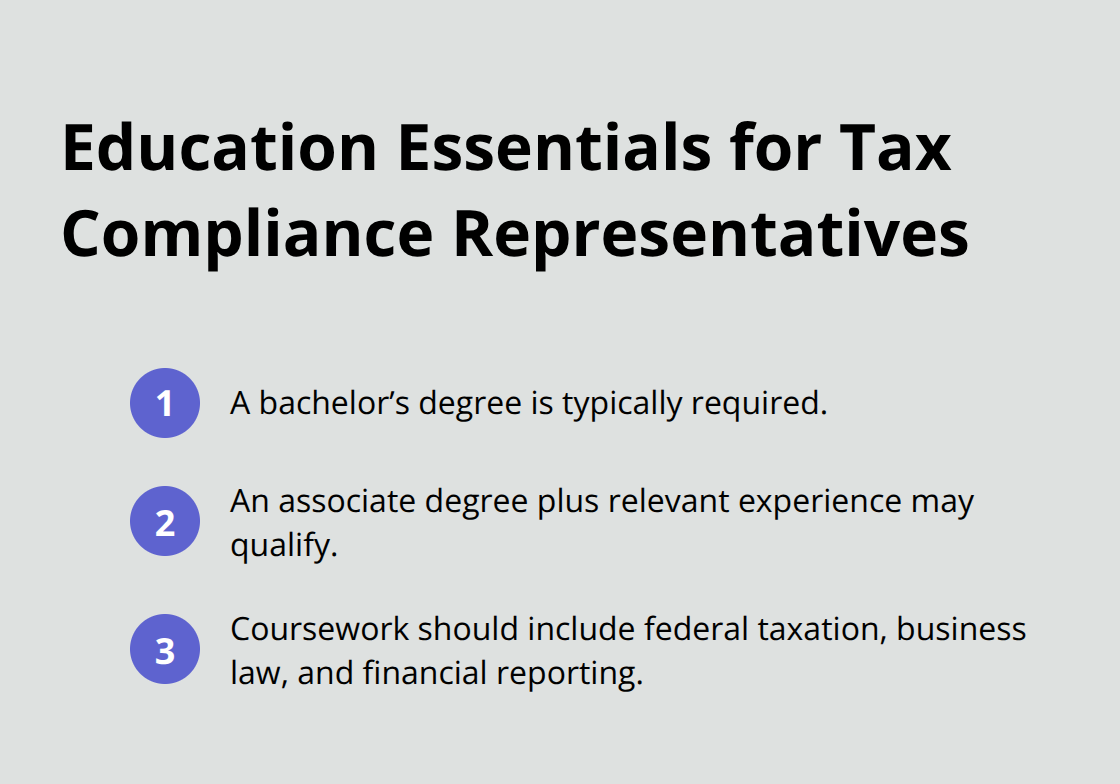
Accounting coursework should include federal taxation, business law, and financial reporting. These subjects provide the foundation for tax compliance work. State positions often mandate specific educational requirements – California requires at least two years of college with basic accounting and business law courses for their Tax Compliance Representative roles.
Professional Certifications That Boost Your Career
The Enrolled Agent credential stands out as a valuable certification for tax compliance work. This IRS-recognized credential allows representation before all IRS offices and significantly boosts your prospects with employers. To become an Enrolled Agent, candidates must obtain a Preparer Tax Identification Number, apply to take the Special Enrollment Examination (SEE), and achieve passing scores on all 3 parts of the SEE.
Certified Public Accountant licenses offer broader career flexibility but require 150 credit hours and state-specific exams. Many employers value the Certified Internal Auditor designation for compliance roles that involve internal controls and risk assessment.
Continuous Education Requirements
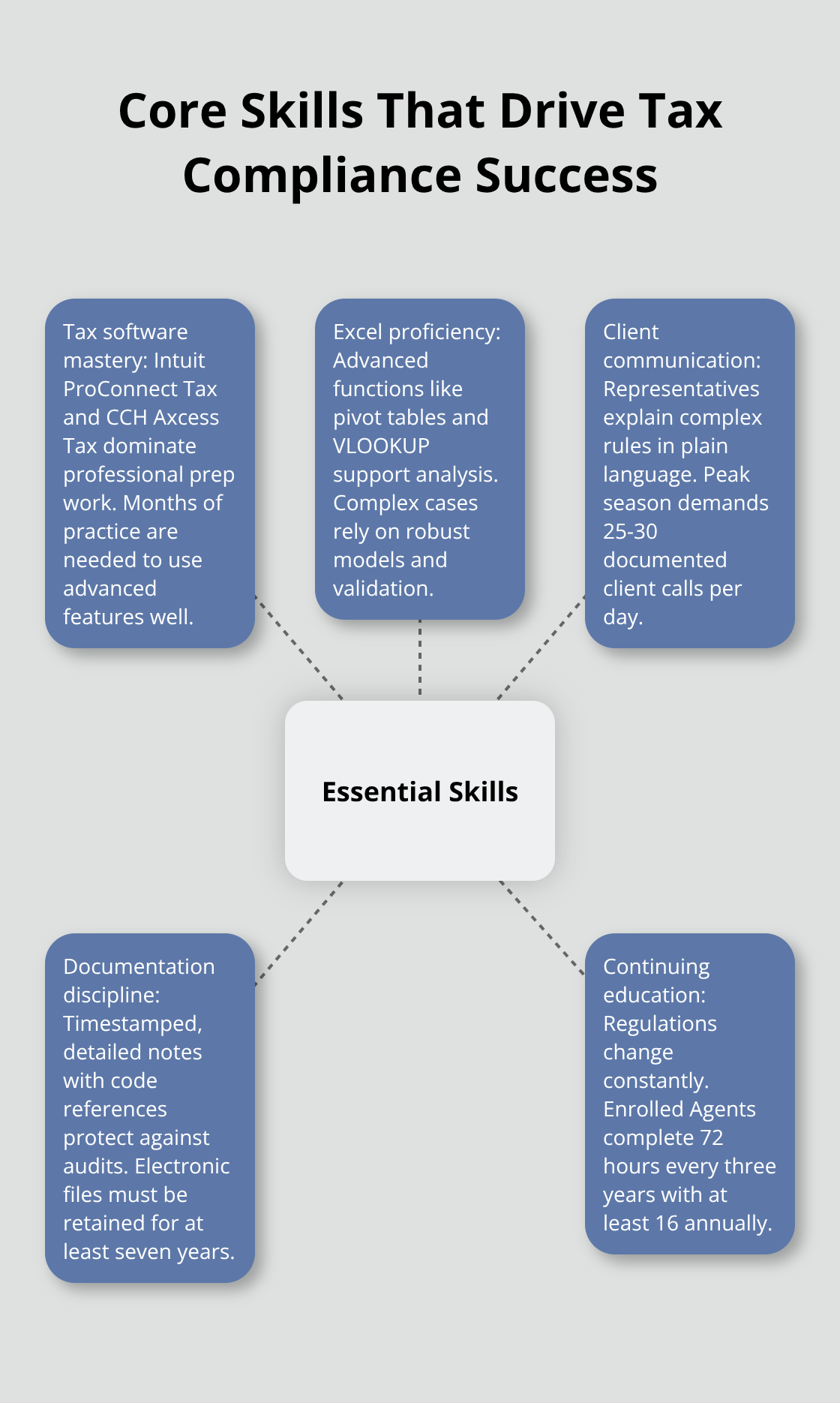
Tax regulations change constantly, which makes continuous education non-negotiable. Enrolled Agents must complete 72 hours of education every three years (with at least 16 hours annually). Most employers provide internal programs that cover software updates and regulatory changes.
Professional organizations like the National Association of Enrolled Agents offer specialized courses and webinars. Tax preparation software companies such as Intuit and Wolters Kluwer provide free sessions during tax season. Smart professionals attend these sessions to master tools like ProConnect Tax and CCH Axcess Tax, which are industry standards.
These educational foundations and certifications prepare you for the technical demands of tax compliance work. The next step involves mastering the specific skills and daily responsibilities that define success in this field.
Essential Skills and Responsibilities
Tax compliance representatives must master specific software platforms that dominate the industry. Intuit ProConnect Tax and Wolters Kluwer CCH Axcess Tax represent the gold standard for professional tax preparation. Microsoft Excel proficiency remains non-negotiable, particularly advanced functions like pivot tables and VLOOKUP for data analysis. The Bureau of Labor Statistics provides comprehensive wage data for tax compliance positions, with experienced professionals commanding higher salaries based on their technical expertise with these systems.
Technical Tax Knowledge and Software Proficiency
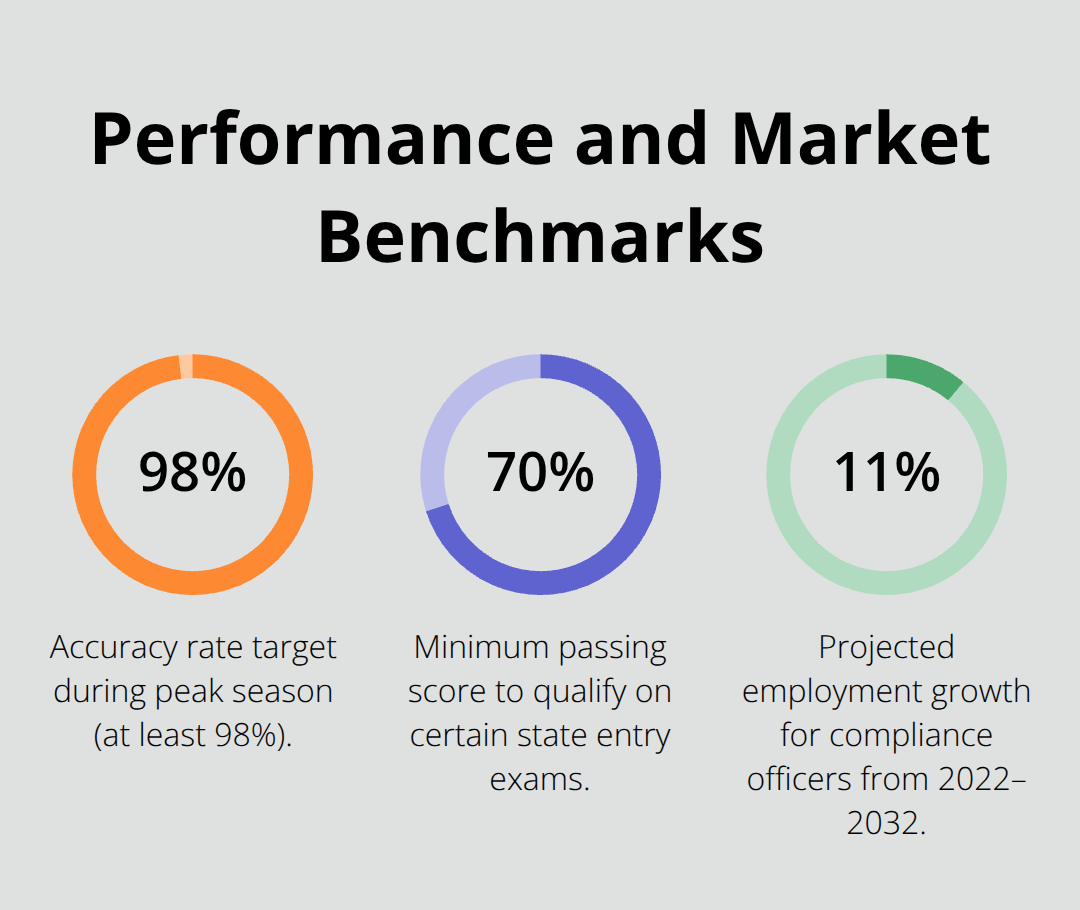
Professional tax software requires months of dedicated practice to achieve competency. Most employers provide 40-80 hours of initial training on their primary platforms, but successful representatives invest additional time to learn advanced features. Tax season demands processing 15-20 returns daily while maintaining accuracy rates above 98%. Excel skills separate average performers from top earners – complex tax situations require sophisticated spreadsheet models and data validation techniques that streamline workflow efficiency.
Communication and Client Interaction Skills
Tax compliance work involves constant interaction with stressed clients who face financial penalties. Representatives must explain complex regulations in simple terms while they maintain professional boundaries. The IRS emphasizes continuing education for tax professionals, which means representatives spend significant time staying current with regulations rather than just processing returns. Phone skills matter most – successful representatives handle 25-30 client calls daily during peak season while they document every interaction for legal protection (written communication skills prove equally important for audit correspondence and penalty abatement letters).
Documentation and Record-Keeping Duties
Accurate record-keeping protects both representatives and their employers from IRS scrutiny. Every client interaction requires detailed notes with timestamps and specific tax code references. Electronic filing systems must maintain backup copies for seven years minimum.
State positions like California’s Tax Compliance Representative role demand meticulous attention to documentation standards, as government audits review every decision. Representatives who master documentation workflows process cases 40% faster than colleagues who rely on informal note-taking systems (this efficiency directly impacts career advancement opportunities).
These technical and interpersonal skills form the foundation for career success, but understanding the broader job market and advancement potential helps professionals make informed career decisions.
Career Path and Job Market Outlook
Entry-Level Positions Lead to Rapid Advancement
Tax compliance representatives typically start as Program Technicians or Junior Tax Specialists, with salaries between $35,000 and $45,000 annually. California state positions offer monthly salaries starting from approximately $3,649, with continuous application processes that accept candidates year-round. Entry-level roles require candidates to pass a state exam with a minimum score of 70%, but veterans receive preference under Government Code Sections 18973-18979.
Most new hires advance to senior positions within 18-24 months when they demonstrate strong performance during tax season. The structured government advancement system provides clear promotion pathways, unlike private sector roles where advancement depends on company politics. State employees also gain access to comprehensive benefits packages that include health coverage and retirement plans.
Salary Growth Accelerates with Experience
The Bureau of Labor Statistics reports a median salary of $52,800 for Tax Compliance Representatives, but experienced professionals earn $80,000 to $100,000 annually in major financial centers. Geographic location significantly impacts compensation – professionals in New York and California command 25-30% higher salaries than national averages.
California state employees benefit from comprehensive CalPERS pension plans, health benefits that cost less than federal options, and substantial paid time off that promotes work-life balance. Remote work options have expanded since 2020, though tax season still requires office presence for most positions (particularly for complex audit cases).
Industry Demand Shows Strong Growth Potential
Employment for compliance officers projects 11% growth from 2022 to 2032, much faster than average occupations according to Bureau of Labor Statistics data. Approximately 88,000 job openings emerge annually, driven by increased regulatory complexity and business expansion. Automation handles routine tasks, but complex cases require human expertise, which makes analytical skills more valuable than ever.
Accounting, tax preparation, and payroll services represent the largest sectors for new hires, followed by state and local government agencies. Smart professionals specialize in international tax compliance or corporate structures to command premium salaries and secure advancement opportunities in this competitive field (specialization often leads to 20-30% salary increases within three years).
Final Thoughts
A Tax Compliance Representative career requires a bachelor’s degree in accounting or finance, though associate degrees with experience work for some positions. The Enrolled Agent credential provides the strongest competitive advantage, while continuous education keeps professionals current with changing regulations. Success demands mastery of tax software like ProConnect Tax and CCH Axcess Tax, plus advanced Excel skills for data analysis.
Strong communication abilities help representatives explain complex tax issues to stressed clients during peak season workloads. Career prospects remain excellent with 11% projected growth through 2032 and median salaries of $52,800 that reach $100,000 for experienced professionals in major markets. California state positions offer structured advancement and comprehensive benefits (including CalPERS retirement plans).
Start with required coursework in federal taxation and business law, then pursue the Enrolled Agent examination. Gain experience through internships or entry-level positions while you build software proficiency. We at Optimum Results Business Solutions help small service-based businesses and tech startups maintain regulatory compliance through expert bookkeeping and accounting services.